Welcome: Henan Sinowin Chemical Industry Co.,Ltd.
Language:
 ∷

∷
 ∷
Production Processes and Classification of Polyacrylamide (PAM)
I. Aqueous Solution Polymerization
Advantages: Low cost, simple equipment, high safety, and the ability to achieve very high molecular weights; suitable for large-scale production of 25kg-bagged dry powder.
1. Ingredient Preparation and Purification: Deionized water is mixed with purified acrylamide (AM). For anionic PAM, acrylic acid (AA) is added; for cationic PAM, cationic monomers such as DMC or DAC are added. The pH is adjusted, and nitrogen gas is introduced to remove oxygen (as oxygen inhibits polymerization).
2. Initiation and Polymerization: A redox initiation system is added (most commonly ammonium persulfate combined with sodium bisulfite, often supplemented with an azo initiator). The temperature is maintained between 20–50°C, and adiabatic polymerization proceeds for 2–6 hours, resulting in a solid, elastic gel block.
- Non-ionic PAM: Produced via the homopolymerization of AM.
- Anionic PAM (APAM) – Two methods:
① Homopolymerization followed by hydrolysis (the mainstream approach): A non-ionic gel block is first produced, then hydrolyzed by heating with NaOH to introduce carboxyl groups. The degree of hydrolysis can be adjusted, and this method yields higher molecular weights (commonly used for high-molecular-weight APAM in oilfield applications).
② Copolymerization-hydrolysis: AM and acrylic acid are polymerized together; this process is simpler, though the resulting molecular weight is slightly lower.
- Cationic PAM (CPAM): Produced by the direct copolymerization of AM and cationic monomers. This type cannot undergo strong-alkali hydrolysis; the ionic degree is controlled by the ratio of monomers, and the production cost is higher.
3. Granulation: The gel block is cut or shredded into smaller gel particles.
4. Hot-Air Drying: The particles are dried at 80–120°C to a moisture content of <10%. The temperature must be carefully controlled; excessive heat can cause molecular weight degradation or cross-linking, rendering the polymer insoluble.
5. Pulverization and Sieving: The material is ground into powder and sieved (typically 80–120 mesh).
6. Quality Testing (molecular weight, ionic degree, dissolution rate, residual acrylamide content) and Packaging.
II. Inverse Emulsion Polymerization (Emulsion PAM, Liquid Product)
Water-in-oil (W/O) system: An aqueous solution of AM serves as the dispersed phase, while kerosene or a similar hydrocarbon acts as the continuous phase. White oil serves as a continuous oil phase; an emulsifier is added to disperse the substance into micro-droplets, which are then polymerized.
III. Inverse-Phase Suspension Polymerization
Monomer droplets are suspended and polymerized within an organic solvent, yielding polyacrylamide (PAM) directly in the form of beads (pearl-like particles).
IV. Dispersion Polymerization (A Newer Method)
A water-based dispersion process that avoids the use of large quantities of organic solvents. The resulting product is a water-based dispersion; it dissolves rapidly and is primarily used in high-end papermaking and as an additive for coatings. Production capacity is relatively limited.
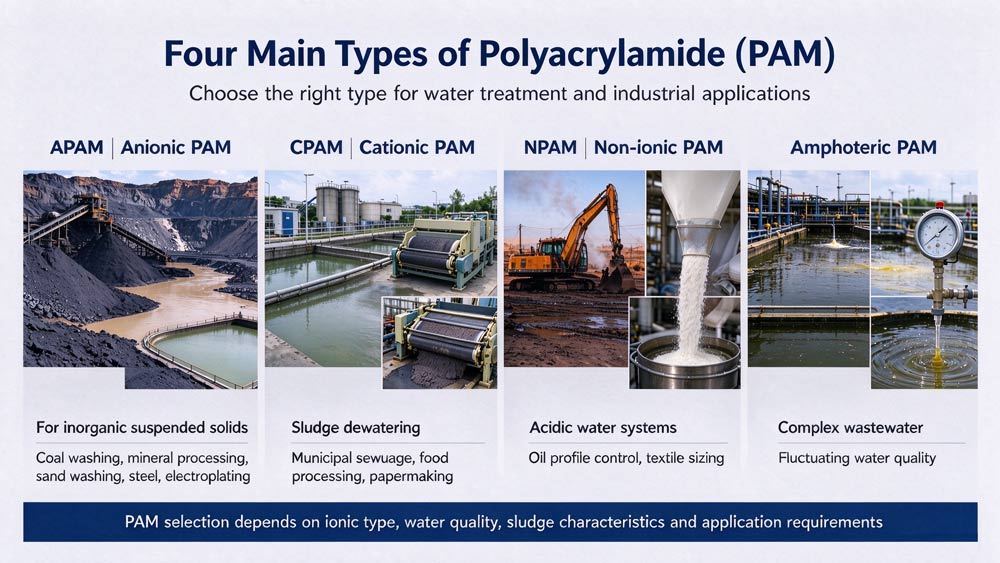
Four Main Types
1. APAM (Anionic PAM)
Suitable for wastewater containing inorganic suspended solids—such as that from coal washing, mineral processing, sand and gravel plants, electroplating facilities, steel mills, and water treatment (clarification). It is most effective in alkaline pH conditions and is the most affordable option.
2. CPAM (Cationic PAM)
Primarily used for sludge dewatering (including sludge from municipal sewage, slaughterhouses, food processing, and papermaking) and for treating organic-rich wastewater. It is categorized by its ionic degree (ranging from 10 to 60) and is the most expensive type.
3. NPAM (Non-ionic PAM)
Used for acidic water systems, profile control in oil wells, soil moisture retention, and textile sizing.
4. Amphoteric PAM
Used for complex wastewater characterized by significant fluctuations in water quality; this type is less frequently employed.
Contact: Sophia
whatsapp:
 Sophia
Phone: +86 13283888407
Tel: 086-0371-63360817
Email: info@sinochemi.com
Add: NO.28,Sanquan Road, Zhengzhou, China

 chinasinochemical